
No Perfect Choice: Reframing the Stress around Decision-Making
3 Ways to Reframe Decision-Making and Reduce Stress

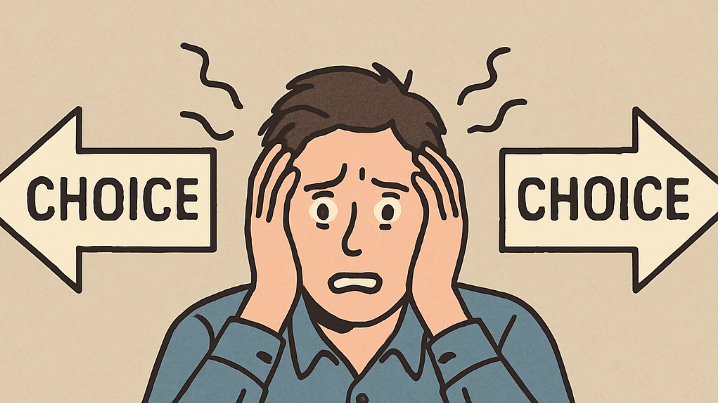
You probably agree that making decisions can be stressful.
Major decisions can be stressful (like: ‘Should I move here? Or take this job? Or date/marry this person?”). Minor decisions can be stressful (“How many people should I invite for dinner? Who? When?”).
Unfortunately, that stress means that sometimes people are too paralyzed to make a decision. So they simply fail to act.
I’ve found three ways helpful to reframe decision-making so that it can be less stressful.
Reframe #1: I’m lucky to get this decision-making practice
When you’re feeling stressed about making a difficult decision, instead of focusing simply on how stressed you are, you might consider thinking: “I’m lucky to have this time to practice making a difficult decision.”
One way to get better and more comfortable at making decisions is to practice making decisions, and take note of the process you used.
A year ago, I had to make a difficult decision about whether or not to take a job. I could either: 1) take the job as it was offered, 2) decline the offer, or 3) negotiate the offer. I was working with limited information and under time pressure. I didn’t know what to do.
I spoke to several acquaintances about the struggle the day I had to make the decision. “No matter what happens,” I said, “at least I’m getting practice making the decision.”
I realized that the process itself – regardless of the outcome – was valuable. That helped me recognize that there was a purpose to some of the struggle I was going through.
Reframe #2: There’s no “best” choice
Many of the decisions we make have no “optimal” outcome.
For example, what is the “best” city to live in? Or the “best” job to have? Or the “best” table at the restaurant?
Clearly, there’s no right answer to the above questions, in most cases. There are pros and cons to each.
When I recognized the fact that there’s often no “best” decision, I felt freedom to stop second-guessing my decisions.
Above, I mentioned that one way to get better at making decisions is to make decisions, and then make note of the process you used. But in cases of small decisions, I don’t think this is necessary. Instead, what’s helped me more is to realize that it’s not a make-it-or-break-it decision, and then try to be comfortable with the outcome.
Reframe #3: Considering options isn’t a waste of time, even if you don’t change course
Is it a waste of time to consider other options, if you then don’t choose them?
For example, is it a waste of time to consider a new job if you end up staying in your old job, or to consider moving even if you don’t end up moving?
I don’t think it’s a waste of time. That’s because: even if you end up staying with your old course of action, you’ve now made an affirmative decision to do so.
If you’re considering changing course, there’s probably a reason you’re considering that.
Generating other options can you understand available opportunities. And, as you work through the process of figuring out whether to choose one or the other, you will probably realize that you hold values which you didn’t realize you held.
In other words, the process of considering options and making a decision can help you understand your values. Even if you choose to go with the original decision, you’ve probably now clarified a value that you didn’t know you held. And you’ve made an affirmative, active decision (instead of a passive decision) to stay in your current situation.
Summary
I’ve found these three re-frames helpful.
Seeing decision-making as practice – View decisions as opportunities to strengthen your decision-making skills. Each decision, regardless of outcome, can be valuable experience.
Realize there’s often no best choice -- Many decisions have no single optimal answer. Recognizing this can free you from overanalyzing and allow you to confidently move forward.
Be comfortable rejecting options you consider – Even if you ultimately stick with your original choice, exploring alternatives helps clarify your values and makes your decision intentional and active rather than passive.
Great insights! Thanks!